The problem
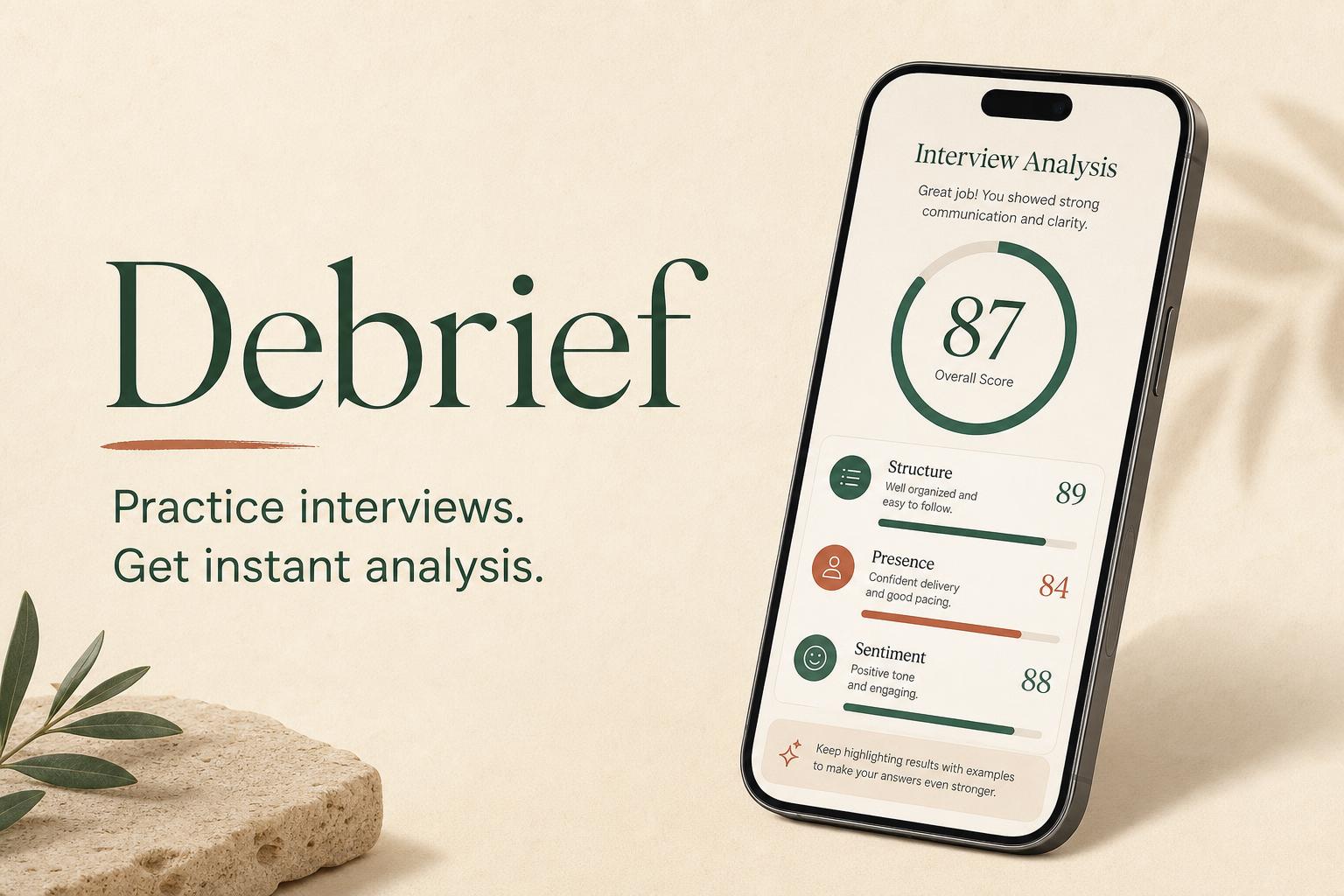
Job seekers have no structured feedback loop after an interview. Memory is distorted by adrenaline, and hiring outcomes are noisy signals shaped by factors outside the candidate's control. No tool existed for the post-interview moment.
My role
- Identified market gap from personal experience and validated through competitive research
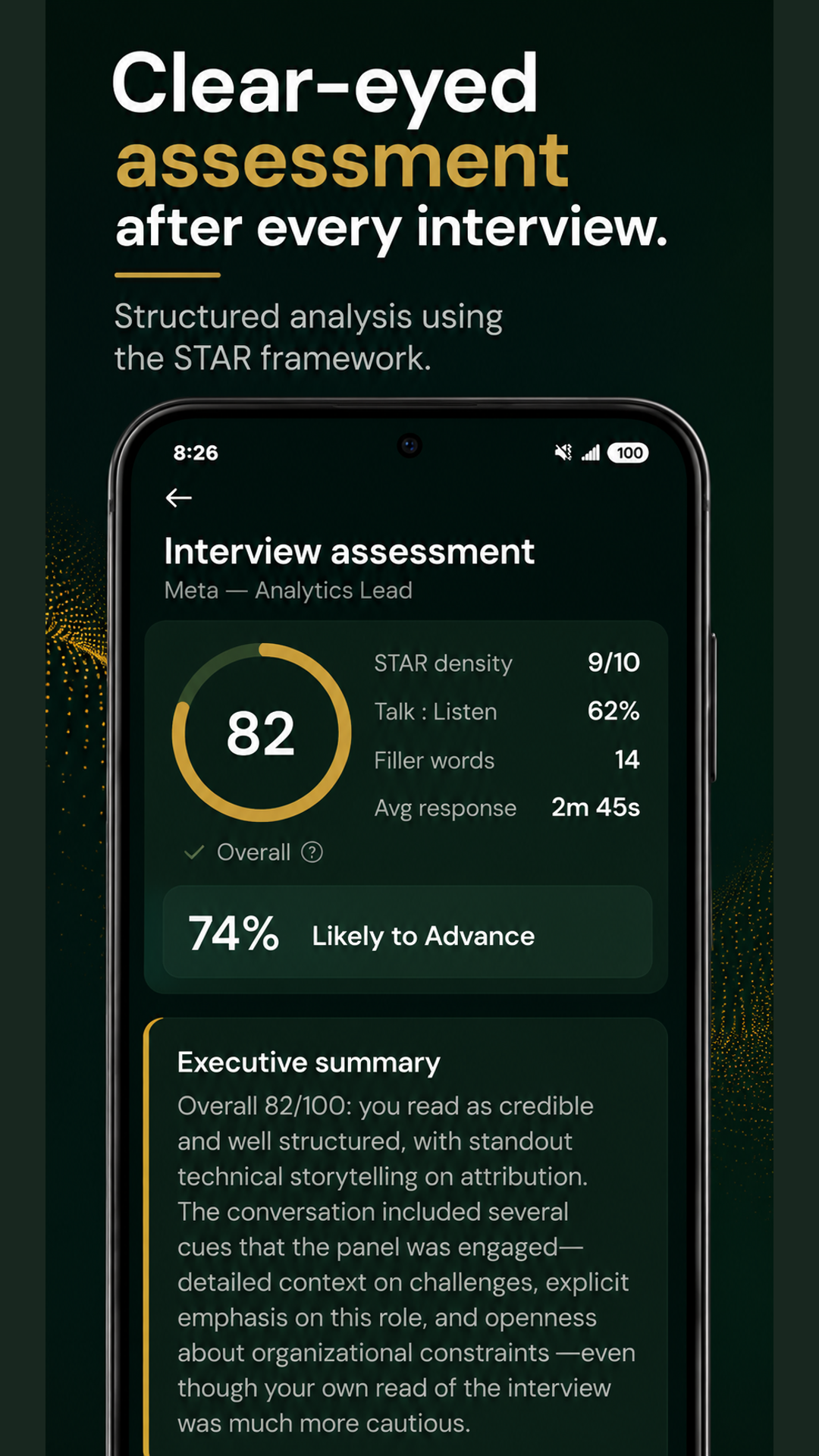
- Defined I/O psychology rubric covering STAR structure, executive presence, perception gap, sentiment, filler word density, and talk ratio
- Built app in React Native using Claude (Anthropic) as inference engine
- Designed and executed Google App Campaign with creative testing across portrait/landscape orientations and multiple copy variants
- Recruited beta testers via Upwork; synthesized 3 structured UX/QA reports into a prioritized bug and feature backlog
- Managed end-to-end: product, marketing, and analytics
Process & methods
- Competitive analysis: Afterview.ai, Yoodli, Final Round AI, Big Interview
- User research: 3 beta testers with structured feedback protocol; identified 12 functional bugs, 20 UI/UX issues, and 6 UX improvement recommendations
- Paid acquisition: Google App Campaign. Portrait video outperformed landscape; 'Track Sentiment & Chemistry' headline drove highest install rate (19.05% CTR, 5 installs at $1.19/install)
- Analytics: Firebase linked to Play Developer Console and Google Ads
Artifact · Interactive UX wireframe
Full UX flow — every screen in the app
The wireframe shared with beta testers. Core flow (Record → Gut Check → Calibration Report) plus the bottom-tab screens (Home, Pipeline, Reports) and pricing. Scroll inside the frame to explore.
Original Tailwind/HTML wireframe authored in Lovable and distributed to 3 Android beta testers. Open in a new tab for full-screen review: debrief-ux-flow.html.
Where Debrief delights — and where it breaks
Cross-referenced 3 structured reports across 3 Android devices (Galaxy S24, Note 10, Pixel 4a 5G). 38 issues clustered into 12 functional bugs, 20 UI/theme issues, and 6 UX recommendations. Aggregate rating: 8/10.
User action
Find app on Play Store, install
“No long registration forms — email + 6-digit code and I was in.”
Pain point
Geo-availability gap blocked one tester at first launch.
Fix in backlog
Expanded Play Store country targeting; verified install in 3 new regions.
User action
Permissions, sign-in, first tour
“Notification dialog blocks the screen before I know what the app does.”
Pain point
Notification prompt fires on launch; returning users hit a 'already registered' loop after clearing data.
Fix in backlog
Defer notification ask to the wait screen (where value is obvious); rebuild passwordless auth to recognize returning emails.
User action
Record, upload media, or paste
“Only .txt accepted — I had to re-save my PDF.”
Pain point
Mode tabs reset on tap; PDF/DOCX rejected; home screen exposes 3 redundant upload entry points.
Fix in backlog
Fix tab state machine; accept PDF/DOCX/TXT; collapse home page to a single primary New Interview CTA.
User action
App generates report (45s–2min)
“Fast Facts during the wait are great — but they flip too fast to read.”
Pain point
Tip carousel rotates ~40% too fast; push notification on 'Leave & Notify Me' never fires.
Fix in backlog
Slow tip rotation by 1.5×; reconnect FCM trigger to report-complete webhook.
User action
Scan score, perception gap, coaching
“The perception-gap analysis is amazing — it justified the self-rating step.”
Pain point
Score clusters in the 60s regardless of transcript quality; rubric categories feel repetitive; no transcript excerpt linking.
Fix in backlog
Recalibrate scoring against poor/avg/strong reference transcripts; merge overlapping rubric sections; add inline transcript citations to each feedback bullet.
User action
Track interviews across roles
“I tapped the status drawer and nothing happened.”
Pain point
Status drawer non-interactive; can't dismiss by swipe; no filter by company/role; report list shows score only, no summary.
Fix in backlog
Rebuild status drawer with bottom-sheet behavior; add company/role filter + per-card summary preview.
Tester identities and verbatim quotes redacted/paraphrased. Bug IDs and full reports retained in private backlog.
Outcomes
- App live on Google Play with active paid acquisition
- Cost per install ranging $0.71–$3.32 across top-performing assets
- Portrait video (0:25) drove 38 clicks at 15.97% CTR
- Synthesized 3 beta reports into a UX journey map and prioritized backlog: 12 functional bugs, 20 UI/theme issues, 6 UX recommendations — aggregate tester rating 8/10
- iOS launch planned after Android traction validates demand
What I'd do differently
Anonymous onboarding created a segmentation leak — users bypassed profile questions entirely, making it impossible to measure activation by persona. I'd gate anonymous access earlier or eliminate it until core activation metrics were stable.